Accepted to CoRL 2026
How Well Do Latent World Models Understand Partially Observable Safety Constraints?
1UC San Diego 2Carnegie Mellon University
*Equal contribution
Research Overview
How partial observability shapes safe robot control — and how multimodal supervision and calibration can help.
Abstract
Latent world models are becoming a powerful tool for robot control, policy evaluation, and planning because they learn compact state representations and dynamics directly from high-dimensional observations. In this work, we study latent safe control: using world models to safeguard robots against hard-to-model constraints such as overheating or spilling. We ask when a learned latent state contains the safety-relevant quantities needed for control, and what can be done when those quantities are only partially observable. We identify two failure modes: estimation gaps, where the latent state cannot infer whether the system is currently safe, and prediction gaps, where violations are recognizable once they occur but cannot be reliably anticipated from available observations. We study these gaps on two Franka Research 3 hardware tasks: wax melting, where the robot must avoid overheating a plate of wax, and rice pouring, where the robot must manipulate an opaque bottle without spilling its contents. To diagnose the gaps, we use a mutual-information-based measure of safety observability and a rollout-based measure of future safety predictability. To mitigate them, we use privileged multimodal supervision for estimation gaps and conformal risk calibration for prediction gaps. Our results show that multimodal RGB+Thermal or RGB+Tactile information improves safety under partial observability, while RGB-only controllers can become overly conservative or learn poor fallback behavior. More broadly, our work raises the question of when world model state representations are sufficient for reliable robot control.
When Latent World Models Miss What Matters
Latent world models learn compact state representations and dynamics directly from high-dimensional observations such as RGB images. Additional modules, such as safe controllers, can then use these latent states to evaluate actions and intervene before a constraint is violated.
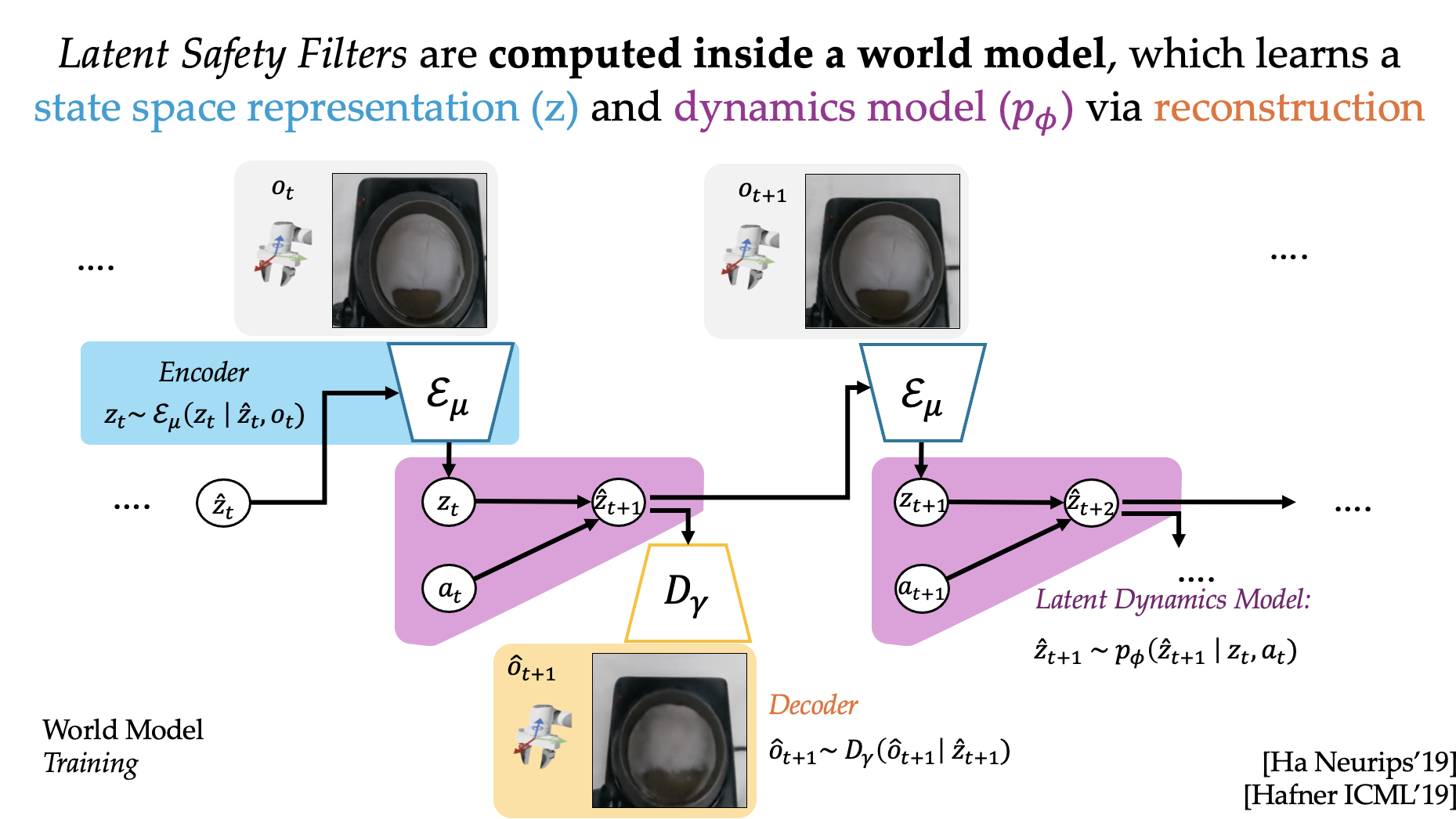
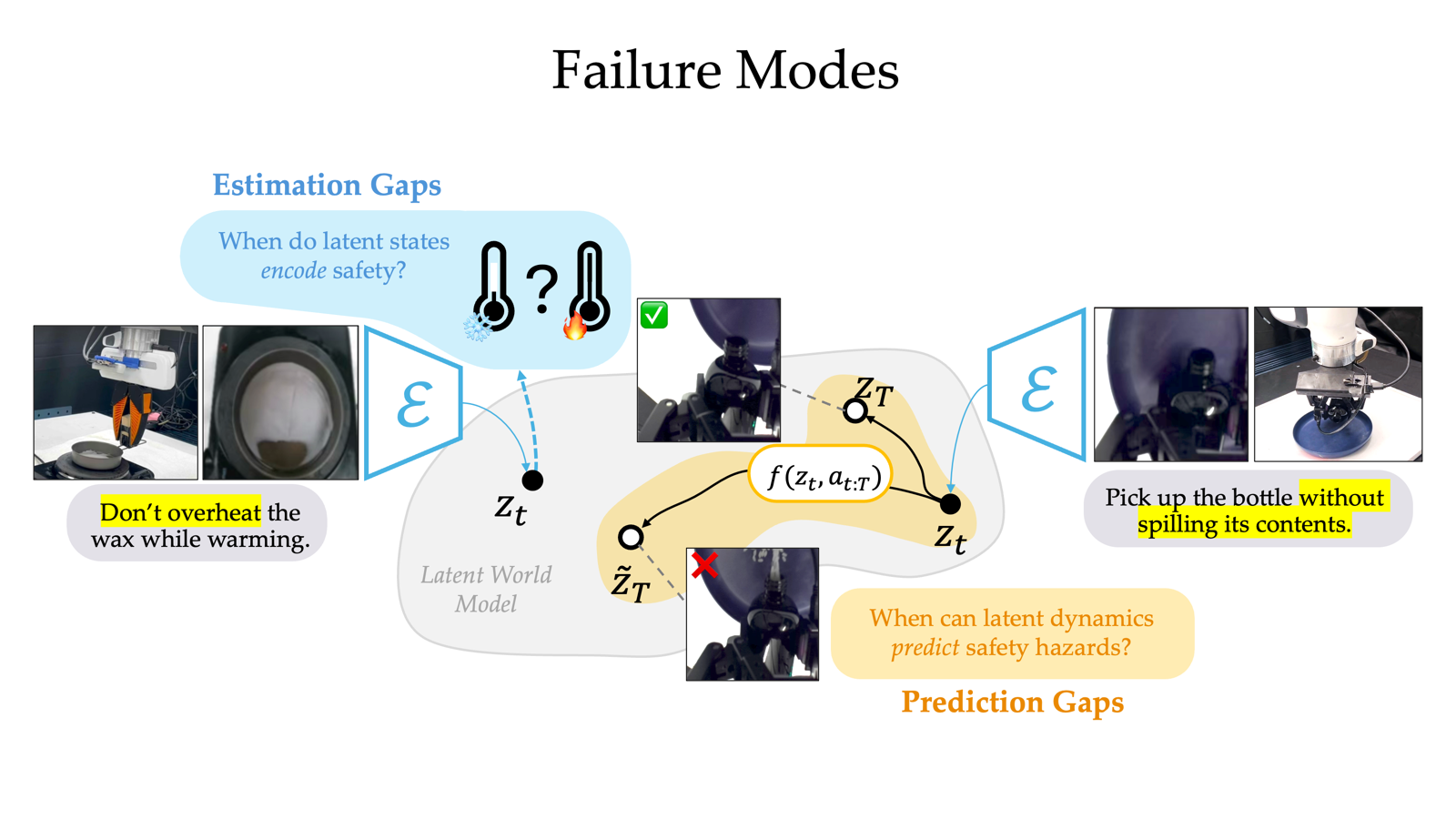
However, when the latent representations provided to these modules lack safety-critical information, the downstream modules may fail to make optimal decisions.
We call these failures estimation gaps when the latent state cannot infer the current safety condition, and prediction gaps when failures are observable after they happen but cannot be reliably predicted before an unsafe outcome. Our experiments diagnose both gaps and test mitigation strategies that make latent safe control more reliable under partial observability.
Hardware Testbeds
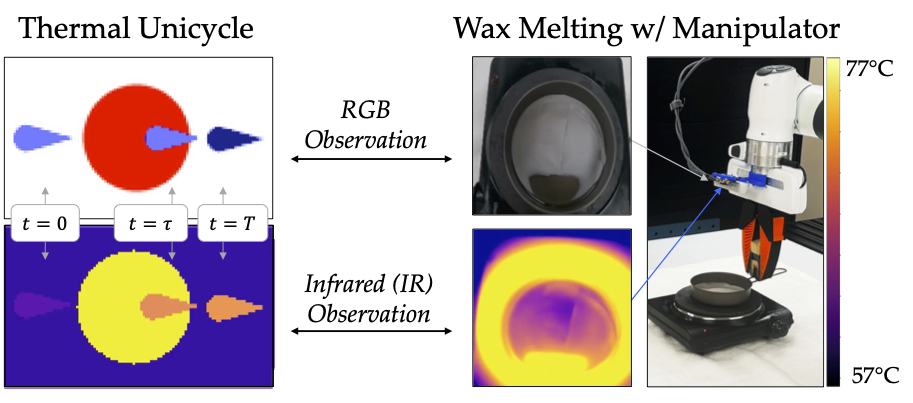
We evaluate latent safety filters on two hardware environments designed to reveal how partial observability impacts safe behavior, using controllers that intervene whenever the world model predicts unsafe behavior.
Wax Melting
The robot must warm a plate of wax without overheating it. RGB images show scene geometry, while thermal observations reveal the hidden temperature.
Rice Pouring
The robot must move an opaque bottle without spilling. Tilting is safe when the bottle is empty, but unsafe when it is filled.
Diagnosing Estimation Gaps with Safety Observability
Estimation gaps arise when the current observation does not reveal the safety-critical quantity needed to decide whether the system is safe. To quantify this, we approximate the mutual information (MI) between observations and safety labels, which measures how much uncertainty about safety is reduced by observing a particular modality.
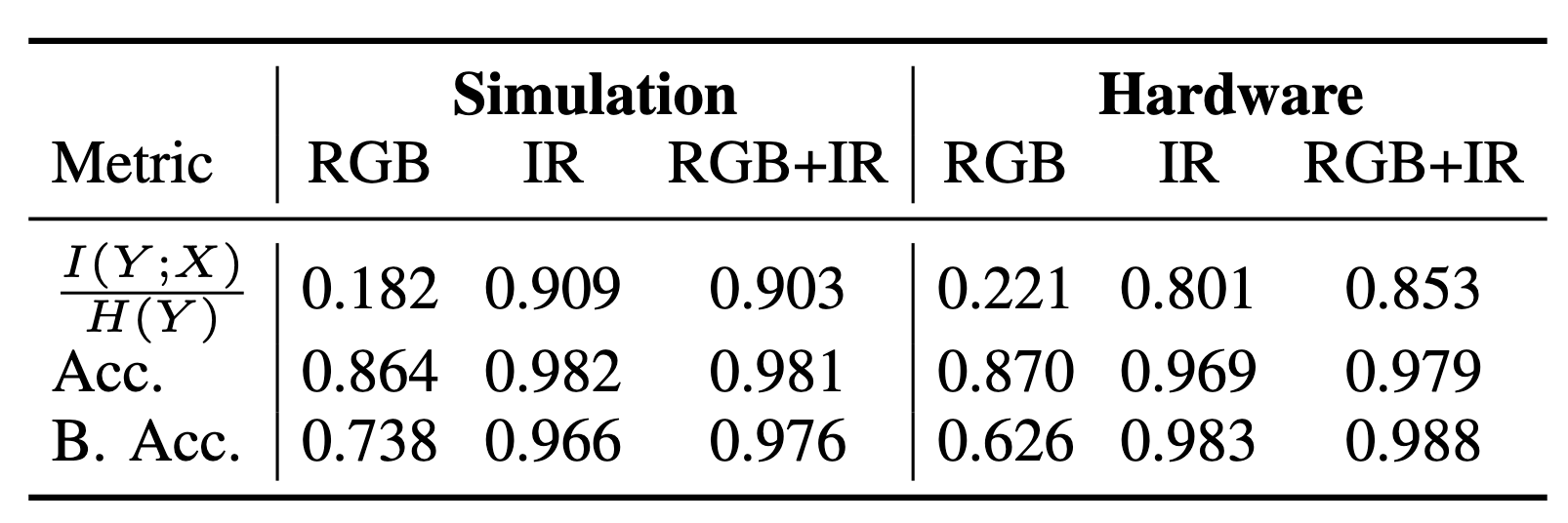
We report MI normalized by the empirical entropy of the safety labels. In the wax task, RGB contains far less safety-relevant information than thermal observations, indicating that an RGB-only latent state may not know whether the wax is near an unsafe temperature.
Diagnosing Prediction Gaps with Rollouts
Prediction gaps occur when a world model can recognize a safety violation after it happens, but cannot reliably imagine whether a candidate action will lead to that violation. In rice pouring, for example, a spill may be visible once rice leaves the bottle, but predicting whether a tilt will spill requires knowing whether the opaque bottle is filled.
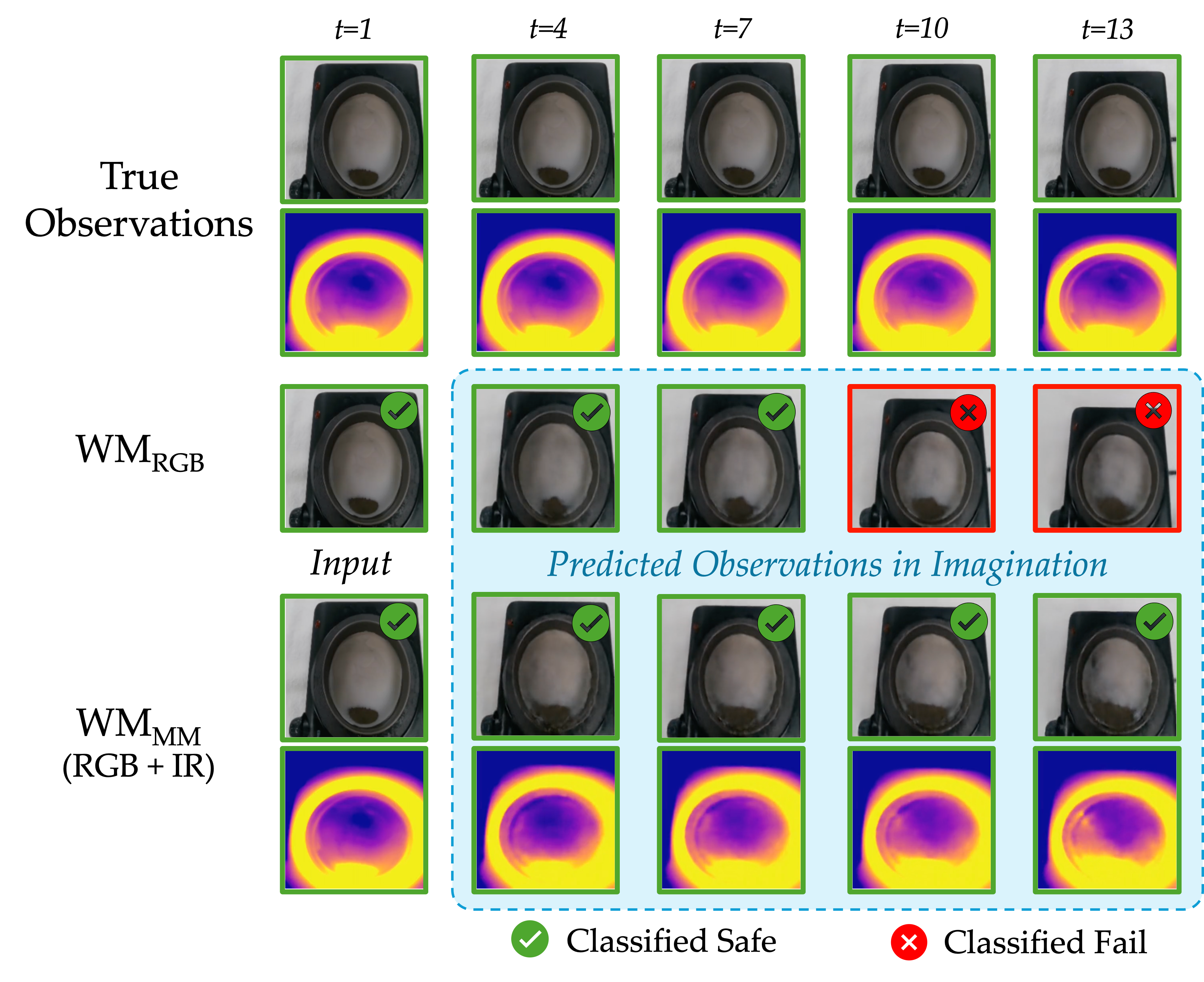
Qualitatively, both world models can predict the visual changes caused by a lifting action, but the RGB-only world model falsely imagines that the same action sequence leads to a safety violation. This suggests that its latent representation has a weaker understanding of how actions correlate with downstream safety outcomes.
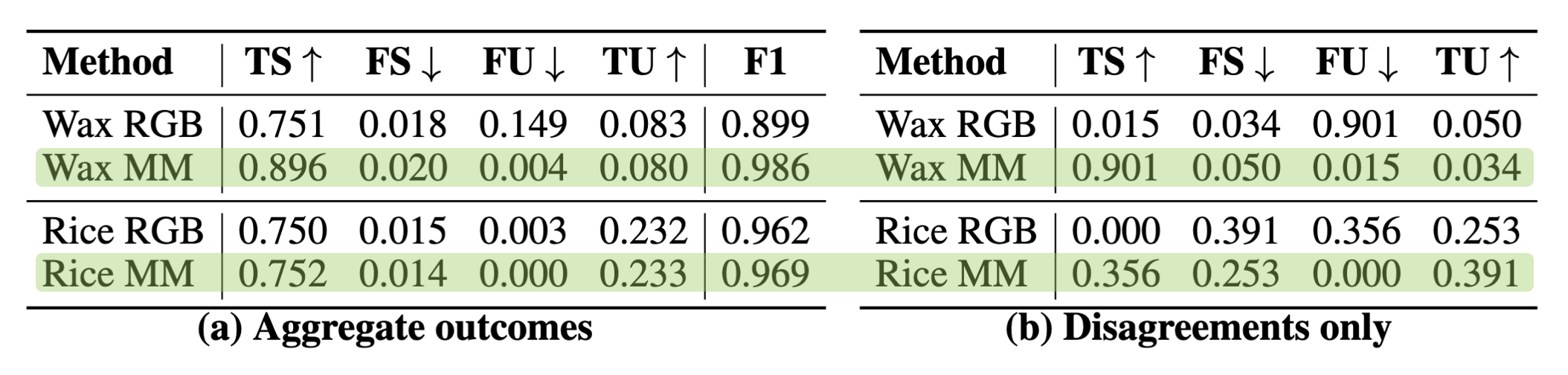
We evaluate prediction gaps by providing three timesteps of history from a held-out evaluation set, rolling each world model forward open-loop for 16 timesteps, and measuring how accurately the rollout predicts future safety outcomes.
Wax Melting: Estimation Gaps on Hardware
In the wax melting task, a robot must warm a plate of wax without melting it. The safety controller intervenes when the world model predicts unsafe behavior, but an RGB-only latent state may not encode the hidden temperature needed to make that prediction.
RGB-Only Safety Filter
The RGB-only safety filter fails to prevent the wax from overheating.
Multimodal Safety Filter
The multimodal safety filter lifts the plate early to avoid overheating.
Mitigating Estimation Gaps: Privileged Supervision
Directly observing safety-relevant quantities improves safe control, but it may not be feasible to deploy robots with a full suite of sensors at scale.
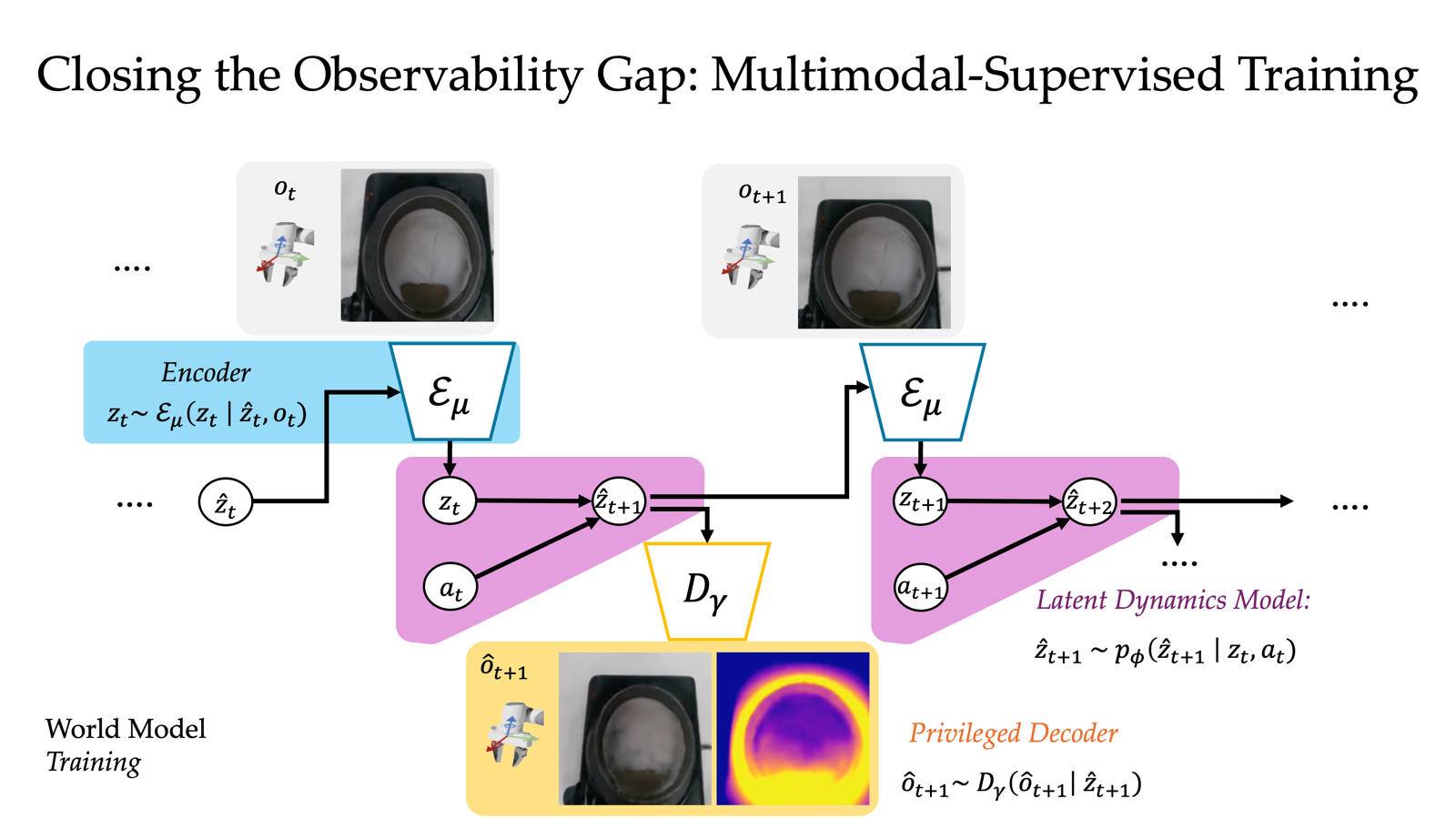
To mitigate estimation gaps, we use privileged multimodal supervision. During training, the world model receives RGB observations and is also forced to predict privileged thermal observations. At deployment, the controller still uses only RGB, but the latent representation has been shaped to encode hidden safety information that matters for the wax temperature constraint.
This allows us to learn an RGB-only controller that safely prevents overheating in all 20 hardware trials, while still operating from RGB observations at runtime.
Mitigating Prediction Gaps: Conformal Calibration
We mitigate prediction gaps at the controller level by calibrating the safety intervention threshold with conformal prediction, controlling the false-safe rate. This lets both RGB-only and multimodal controllers consistently prevent safety violations in the rice pouring task.
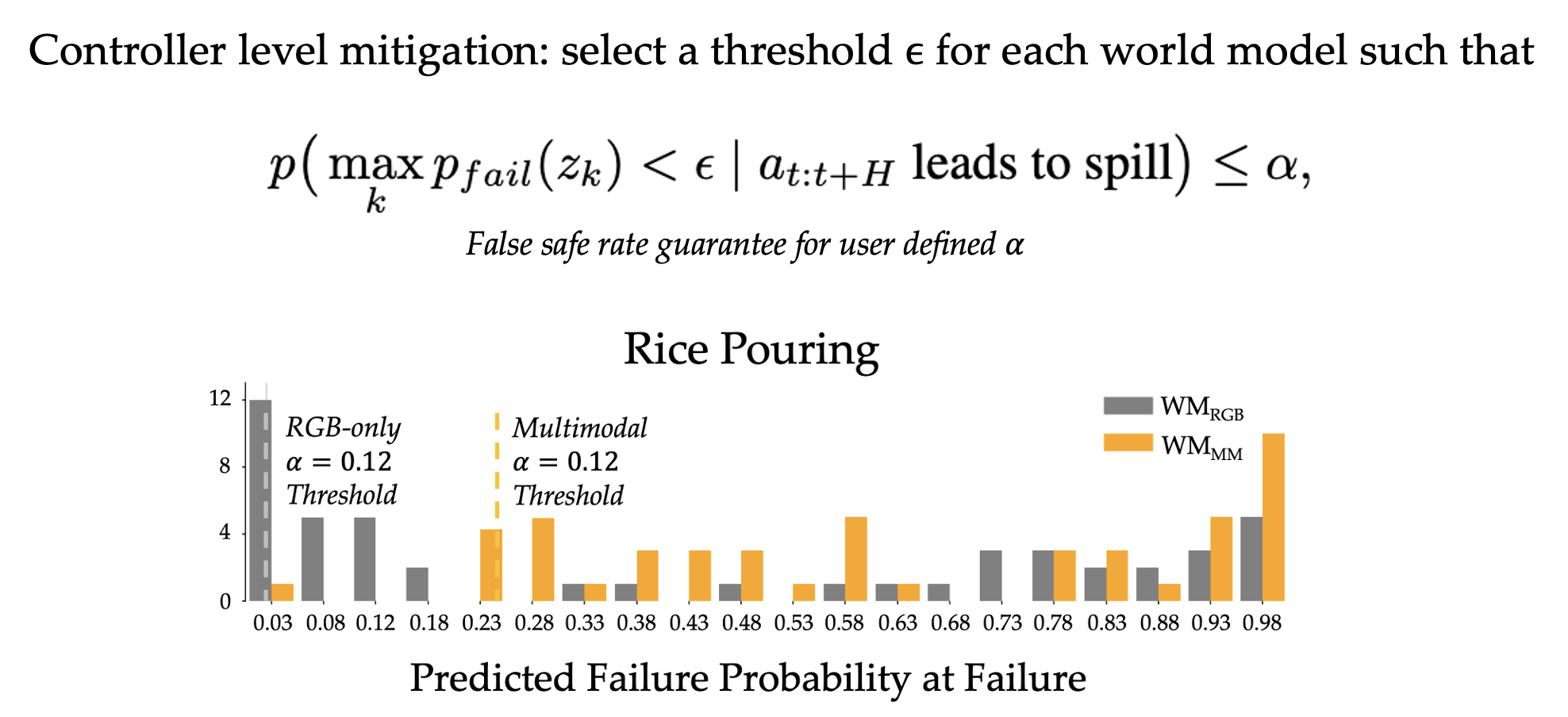
The calibration also reveals the cost of partial observability. When the bottle is empty, the RGB-only world model is extremely conservative and prevents tilting motions that are actually safe. The multimodal model can use tactile information to understand that the bottle is empty, allowing safe tilting without spilling.
RGB-Only Controller
Empty Bottle
Filled Bottle
Multimodal Controller
Empty Bottle
Filled Bottle
Takeaway
These results show that latent world models trained under partial observability can induce myopic safe-control behavior: the controller may avoid seeing failures rather than preventing them, or become overly conservative when hidden state information is missing.
BibTeX
    @inproceedings{kim2026latentworldmodelsunderstand,
      title={How Well Do Latent World Models Understand Partially Observable Safety Constraints?},
      author={Matthew Kim and Kensuke Nakamura and Andrea Bajcsy},
      year={2026},
      booktitle={Conference on Robot Learning},
      url={https://arxiv.org/abs/2510.06492}
    }